
Teeth bonding vs. veneers? There isn’t a single correct answer for every smile. There are many different options to improve the look of your smile. They include whitening your teeth and correcting imperfections like stains and chips.
When you lose a tooth, one of the best options for tooth replacement is dental implants. They look and feel like natural teeth, and they last almost as long as your natural teeth.
But if you’re looking to correct imperfections rather than replace a tooth, you may consider teeth bonding or veneers. Both are excellent ways to correct chips, close gaps between teeth, and give you a whiter, brighter smile.
Teeth Bonding vs. Veneers vs. Professional Teeth Whitening
If you wish only to whiten your smile, professional teeth whitening may be the best choice for you. Whiter teeth might not mean healthier teeth, but many patients simply want to feel more confident when they smile.
Today, we view our own image more than ever before. Whether you’re looking at a selfie you just took, FaceTiming with your grandkids, or in a Zoom meeting, you’re probably very conscious of your appearance. And you want to put your best smile forward.
If your teeth are already straight, unchipped, and evenly spaced, ask your dentist about teeth whitening. There are numerous over-the-counter whitening options, but the Canadian Dental Association recommends having your teeth examined by a professional dentist before trying off-the-shelf products.
So, when is it best to consider teeth bonding vs. veneers to improve your smile? Let’s walk through the approach, cost, and durability of each procedure.
Teeth Bonding
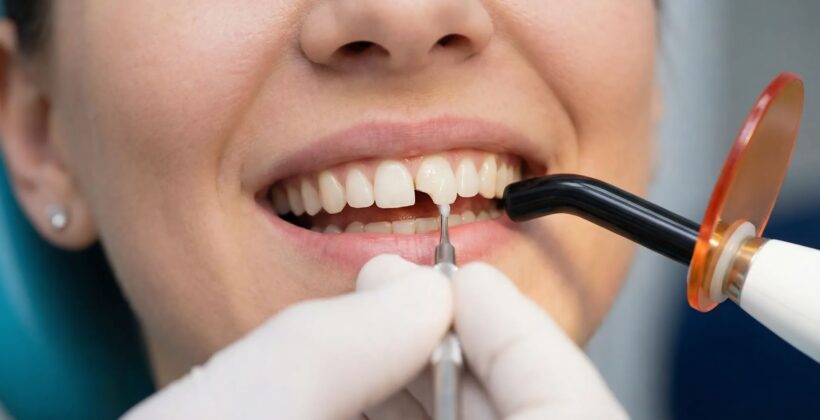
Teeth bonding is also known as dental bonding or bonded restoration. It’s a quick, virtually pain-free way to make minor tooth repairs, and it’s typically completed in a single visit.
During a teeth bonding treatment, a tooth-coloured composite resin is applied to your tooth, carefully shaped by your dentist, and hardened with a curing light. Because the tooth surface only needs light roughening rather than any enamel removal, the process is considered reversible.
The composite resin can be shaped to correct chipped teeth, close gaps, or fix a small crack, and it’s blended to match the surrounding enamel so the correction looks natural. If you prefer a slightly brighter finish, ask your dentist if the shade can be adjusted for a whiter overall smile.
Composite resin is more porous than porcelain, so bonding can pick up stains over time and generally lasts anywhere from three to ten years, depending on how well it’s cared for. When it wears down or dulls, a simple touch-up visit refreshes the result.
Dental Veneers
Dental veneers are thin shells, custom-shaped and bonded to the front of your teeth. They’re usually made of porcelain, though composite resin veneers are also an option. Porcelain veneers are stronger and more stain-resistant, but generally take at least two visits; composite resin veneers can often be completed in a single visit, similar to bonding.
For porcelain veneers, the procedure typically takes two visits. During the first visit, your dentist removes a thin layer of enamel from the front of the tooth to make room for the veneer, and a local anesthetic may be used.
Your dentist then takes an impression to have your veneers custom-made, and may place temporary veneers for the short-term. These are worn until the finished veneers are ready and need to be treated gently, since they can come loose easily. At the second visit, the finished veneers are bonded to your teeth using a composite resin cement.
Porcelain Veneers
Porcelain is denser and less porous than composite resin; hence, veneers resist staining much better and hold their shade for longer.
Composite resin veneers are applied much like bonding in a single visit. Your dentist roughens the tooth surface, layers on tooth-coloured resin across the visible front of the tooth, and hardens each layer with a curing light before shaping and polishing the result. Because they use less material and require little to no enamel removal, resin veneers often cost less than porcelain and can be a good middle ground between bonding and a full porcelain veneer. The trade-off is durability: resin veneers are more prone to staining and typically don’t last as long as porcelain.
Veneers may not be the right fit for everyone. Your dentist may recommend a different treatment if:
- You have tooth decay or gum disease that needs addressing first
- Too little enamel remains on the tooth
- A large portion of the tooth is missing (a crown may be a better option)
- You grind or clench your teeth, since that habit can chip or break porcelain veneers over time
Your dentist at Midland Bay Dental can help you decide if porcelain or composite resin veneers make the most sense for your smile.
Cost and Longevity: Teeth Bonding vs. Veneers
Cost is often the deciding factor between teeth bonding vs. veneers. Bonding is generally the more affordable option upfront. This is because it’s applied directly to the tooth in a single visit with no lab work involved. Veneers cost considerably more, since each one is custom-fabricated in a lab and the process takes two visits.
Bonding usually lasts three to ten years before it needs touching up or replacing, while a well-maintained porcelain veneer can last ten to fifteen years or longer. That longer lifespan is a big part of why veneers come at a higher price, and for patients correcting several front teeth at once, the value can even out over time. Our team will provide current pricing for your specific case at your consultation.
The procedures differ in another important way, too: bonding adds material to the tooth with little to no enamel removal, so it can be adjusted or undone later. Veneers require permanently removing a small amount of enamel to make room for the shell, which is not reversible. That’s worth discussing with your dentist if you’re still deciding between a conservative fix and a longer-term investment.
Caring for Bonded Teeth and Veneers
Whichever option you choose, a few habits will help your results last. Brush and floss bonded and veneered teeth daily, just like your natural teeth. Avoid biting into hard objects like ice cubes or fingernails. Be mindful of hard or chewy foods, since both bonding and porcelain veneers can chip. If you grind or clench your teeth, mention it to your dentist, since bruxism can chip or break bonding and veneers alike.
Keep in mind that veneers can’t be reversed once enamel has been removed. Meanwhile bonding generally can be adjusted or undone. It’s also worth checking with your dental plan ahead of time, since cosmetic treatments like bonding and veneers aren’t always covered, and you may be responsible for the cost yourself.
Visit Midland Bay Dental for a Consultation
If you have one or two small chips, minor gaps, or slight wear and want a same-day, budget-friendly fix, bonding is usually the smarter starting point. Sometimes you need to correct several teeth at once or want a more dramatic colour change. Or you want a result that resists staining for well over a decade. In these cases, porcelain veneers tend to be the better long-term investment.
There’s no universally right answer in the teeth bonding vs. veneers decision – it comes down to the size of the imperfection, your budget, and how long you want the results to last.
Visit Midland Bay Dental for a consultation. Our staff can walk you through the differences between teeth bonding vs. veneers and help you choose the right procedure for your teeth.
Call us at (705) 526-6441 or book an appointment online.
Follow us on Facebook.