
If you’re missing one or more teeth, you’ve probably started looking into your options and considering dental implants vs bridges vs dentures. No single solution works for everyone. Your oral health, how many teeth you’re missing, your budget, and personal preferences all determine the right tooth replacement treatment.
At Midland Bay Dental, we understand that choosing how to replace missing teeth can feel like a big decision. Fortunately, modern dentistry offers several effective options, and your dentist can help you understand how each one fits your needs.
Why Should You Replace Missing Teeth?
A missing tooth is more than a cosmetic concern. According to the Canadian Dental Association (CDA), when you lose a tooth, the remaining teeth can shift or drift into the space. This movement can make the teeth harder to clean and may increase the risk of cavities and gum problems.
Replacing a missing tooth can also help restore your ability to chew and speak comfortably, and depending on where the gap is located, it may help maintain the smile’s alignment. Talking to your dentist early can help you determine which tooth replacement options best fit your needs.
Dental Implants: A Long-Term Option
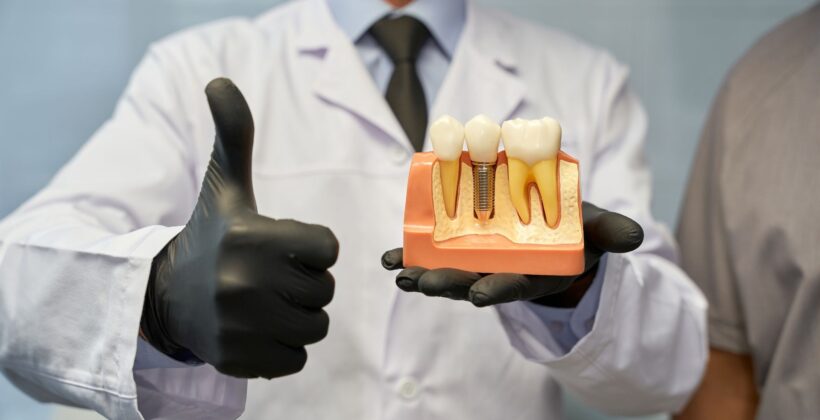
Dental implants replace a missing tooth from the root up. The CDA describes an implant as an artificial tooth root, typically made from titanium, that’s placed into the jawbone. Once it heals, it can support a replacement tooth such as a crown.
This is one of the biggest differences between the three options: unlike a bridge or removable denture, an implant is anchored directly in the jawbone. Implants can replace a single tooth or several missing teeth, and can also support certain bridges and dentures.
That said, implants aren’t automatically right for everyone. The CDA notes that healthy gums, sufficient bone, and overall good health matter. If there isn’t enough bone, you may need a bone graft. Implant treatment also involves surgery and a healing period, so the process can take longer than other tooth replacement options. Your dentist can walk you through the steps to determine if an implant makes sense for you.
Dental Bridges: Filling the Gap
A dental bridge takes a different approach: rather than replacing the root of the missing tooth, a traditional bridge uses neighbouring teeth for support. The replacement tooth sits in the gap and connects to crowns that fit over the supporting teeth on either side. Once placed, it’s fixed in your mouth rather than removable.
One thing to consider is the condition of the teeth beside the gap. The CDA explains that traditional bridges require healthy supporting teeth to hold the bridge in place. For some patients, an implant may be an alternative, since it doesn’t rely on neighbouring natural teeth at all. Bridges work well when you want a fixed solution without a removable appliance, and your dentist can help weigh the two approaches for your situation.
Dentures: Replacing Several or All Teeth
Dentures remain a well-established option, and depending on how many teeth are missing, you may need a partial or complete denture. A partial denture replaces some missing teeth while working around the natural remaining teeth, while a complete denture replaces all the teeth in an upper or lower arch.
The CDA also recognizes overdentures, which are removable dentures designed to fit over and receive additional support from remaining natural teeth or dental implants. This added support can help keep the denture more secure and reduce movement when you eat or speak.
One advantage of traditional dentures is that they’re removable, making them relatively easy to remove for cleaning. At the same time, it can take some time to get comfortable wearing new dentures, and your dentist may need to make adjustments along the way.
Over time, your mouth naturally changes shape, which can affect how your dentures fit. They may eventually need adjustment or relining to maintain a comfortable fit. Regular dental appointments let your dentist check how your dentures fit and recommend adjustments when needed.
What Should You Consider When Choosing?
A few key questions can help guide the decision when it comes to tooth replacement options:
- How many teeth are missing? A single tooth may be replaced with an implant or bridge, while multiple missing teeth might make a partial denture, bridge or implant-supported restoration worth considering. If you’re dealing with a full arch, complete or implant-supported dentures may be the better fit to replace missing teeth.
- What’s the condition of your remaining teeth? Bridges rely on neighbouring teeth for support, so those teeth need to be healthy and strong enough for the job. If they’re not, your dentist may steer you towards alternative options.
- What’s the condition of your gums and jawbone? Implants require healthy gums and enough jawbone to provide a stable foundation. Your dentist may use X-rays or other imaging to assess the area before recommending an implant. If there isn’t enough bone or if gum disease needs to be treated first, your dentist may recommend additional procedures. These could include gum disease treatment or a bone graft to build up the jawbone.
- Do you want a removable or fixed option? Dentures come out for cleaning; bridges and implant-supported crowns stay in place.
- What’s your budget and timeline? Cost varies with the treatment, the number of teeth involved and case complexity. Implants often come with upfront costs that aren’t always covered by every dental plan. The timeline will also vary: some treatments move quickly, while implants require healing time before the final tooth is placed.
Taking Care of Your Replacement Teeth
Whichever option you choose, regular dental care is still an important part of maintaining your oral health. Implants and bridges need the same brushing, flossing and professional care as natural teeth. Your dentist can show you how to clean around an implant or underneath a bridge properly. Dentures need daily cleaning too, and should be checked regularly to make sure they still fit well. Regular visits to Midland Bay Dental help your dental team monitor your replacement teeth alongside your remaining natural teeth and gums.
Explore Your Options at Midland Bay Dental
When deciding between dental implants vs bridges vs dentures, several factors come into play. These include your oral health, the number of missing teeth, the condition of your surrounding teeth and jawbone, as well as your preferences and budget. An examination at Midland Bay Dental can assess your teeth, gums and supporting bone, helping you understand your options through an informed conversation about treatment, benefits and timelines.
If you’re ready to explore your options, contact Midland Bay Dental to book an appointment and take the first step toward restoring your smile.
Call us at (705) 526-6441 or book an appointment online. Follow us on Facebook.